California Housing Affordability: Bay Area vs Central Valley (2026 Guide)
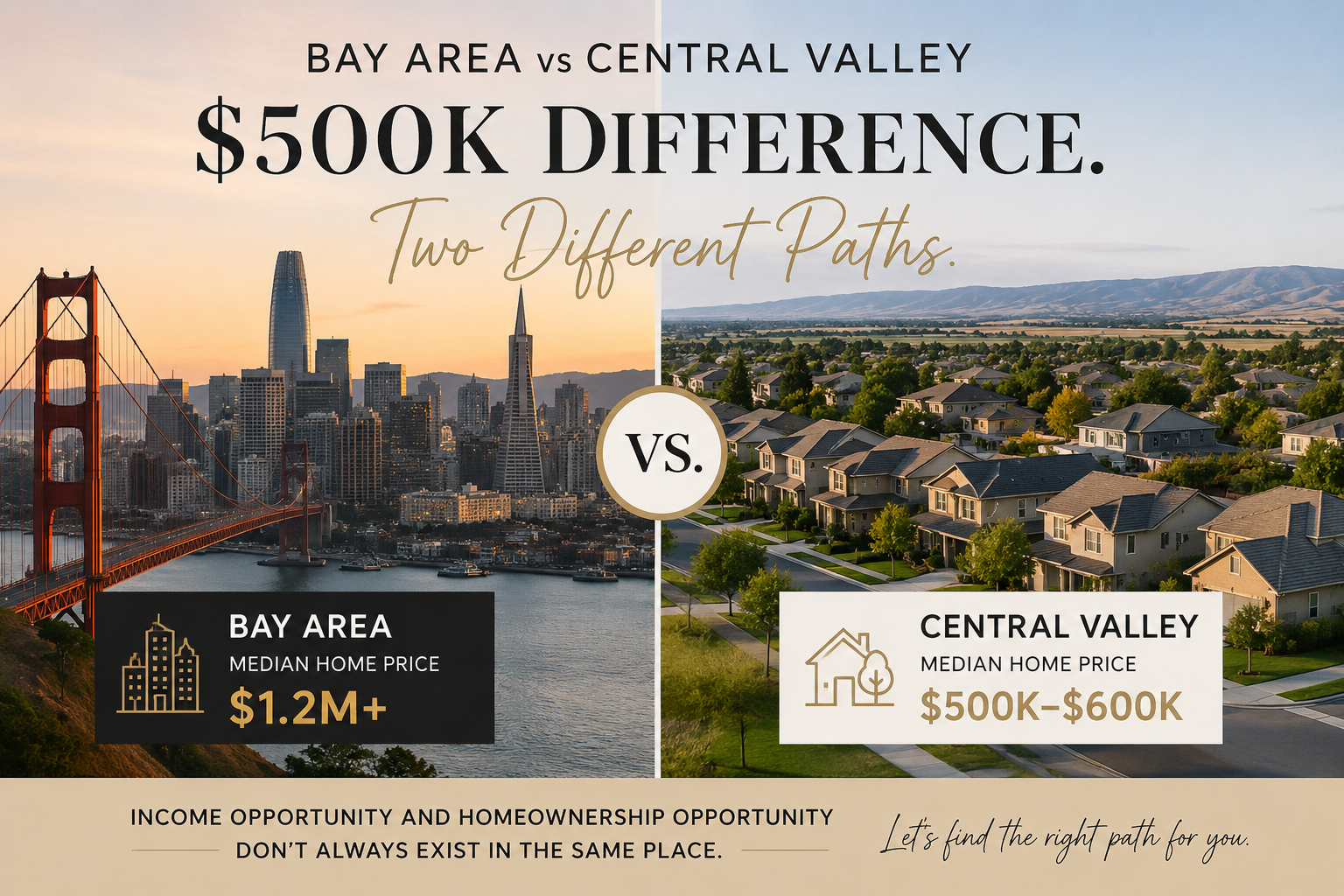
The $500K Gap in California Housing: What It Really Means for Buyers in 2026
Following the recent California Governor Debate on May 5, 2026, one thing is clear:
Housing affordability is no longer just a market issue — it’s a statewide priority.
Across the discussion, candidates approached the issue from different angles. For example, Steve Hilton emphasized:
Reducing regulations that increase construction costs
Limiting legal and procedural delays that slow development
Rethinking where new housing is built across the state
While approaches may differ, the underlying question is the same:
How do we create more realistic paths to homeownership in California?
If you’ve looked at home prices across California recently, you’ve probably noticed something striking:
There’s often a $500,000+ difference between homes in the Bay Area and homes in the Central Valley.
At first glance, it looks simple — one area is more expensive than the other.
But the reality is more complex.
This isn’t just a pricing difference.
It’s a difference in opportunity — and in the path to homeownership.
Why the Bay Area Is So Expensive
The Bay Area continues to command some of the highest home prices in the country — and for good reason.
Higher average incomes
Strong job markets (tech, finance, innovation)
Limited housing supply
High demand
These factors drive prices upward.
But here’s the catch:
Higher income doesn’t automatically mean easier homeownership.
In many cases, home prices have outpaced income growth, making it difficult even for high earners to enter the market.
Why the Central Valley Feels More Attainable
In areas like Stockton, Lathrop, and Manteca, the story looks different.
Lower home prices
More accessible entry points
Growing demand from relocating buyers
For many, the Central Valley represents a realistic path to ownership—especially for first-time buyers or those priced out of coastal markets.
But it also comes with different considerations:
Job location and commute
Income opportunities
Lifestyle preferences
By the Numbers: What the $500K Gap Really Looks Like
To put this into perspective, here’s how the markets generally compare in 2026:
Bay Area (e.g., San Francisco)
Median home price: ~$1.2M–$1.4M
Estimated income needed to comfortably buy: ~$220K+
Monthly payment (with taxes/insurance): ~$7,000–$9,000
Central Valley (e.g., Stockton / Lathrop)
Median home price: ~$450K–$600K
Estimated income needed to comfortably buy: ~$90K–$130K
Monthly payment (with taxes/insurance): ~$2,800–$4,200
The Real Tradeoff: Income vs. Homeownership Opportunity
One of the underlying themes from the debate—and what I’m seeing play out locally—is this:
Not all opportunity exists in the same place.
What we’re seeing across California is a tradeoff between:
Income opportunity (stronger in coastal markets like the Bay Area)
Homeownership opportunity (more accessible in inland markets like the Central Valley)
And for many buyers, those don’t overlap.
That’s where the decision becomes more strategic.
How Buyers Are Thinking About This in 2026
Today’s buyers are asking more layered questions:
Where can I afford to buy?
Where does it make sense long-term?
What kind of lifestyle am I building?
Some are choosing proximity to career hubs.
Others are prioritizing ownership, space, and long-term equity.
The conversation is shifting—and policy discussions like the governor debate are reflecting that shift.
What This Means for You as a Buyer
If you’re considering buying in California, understanding this dynamic is key.
It’s not just about finding a home—it’s about:
Evaluating your income trajectory
Understanding financing options
Choosing a market that aligns with your goals
Getting familiar with the lifestyle aspects of each area of the region
There’s no one-size-fits-all answer.
Final Thoughts
The $500K gap between the Bay Area and the Central Valley isn’t just a number.
It represents two very different paths—and a broader conversation happening across the state.
And as housing continues to take center stage in California policy discussions, understanding where you fit into that picture becomes even more important.
If you’re exploring your options and want clarity on what’s realistic for you, I’m always open to having that conversation.
Drop me an email so I can send you a monthly newsletter with more Northern California regional real estate insights.